

Introduction
One of India’s greatest cultural strengths is its numerous languages. The 2010 census revealed that over 255 million people speak at least two languages, and 87.5 million speak three or more languages. Multilingual education enhances this diversity to create learning more equitable and inviting for all.
But what is multilingual education?
It means teaching in more than one language so that students from different language backgrounds feel important and empowered. This article discusses the advantages and disadvantages of being multilingual, the role of teachers in multilingual classrooms, the meaning of being multilingual, and ways to enhance learning outcomes.
What is Multilingual Education?
Multilingual Education refers to the utilization of multiple languages for instruction and learning. It typically commences with the student’s native language and subsequently introduces other languages, such as Hindi or English. Since 1953, UNESCO has advocated for this methodology, emphasizing its significance in the advancement of cognitive development, social inclusion, and linguistic diversity.
The characteristics of multilingualism include:
- Cognitive flexibility – the ability to switch between different thought processes.
- Cultural awareness – understanding and respecting different traditions.
- Communication skills – being able to speak across diverse contexts.
In India, with its 22 official languages and hundreds of dialects, multilingual education is key to equitable learning. The National Education Policy (NEP) 2020 strongly supports mother-tongue instruction, especially in early grades.
Key statistics:
- Urban: 44% bilingual, 15% trilingual
- Rural: 22% bilingual, 5% trilingual
- Age 20–24: 52% of urban Indians are bilingual
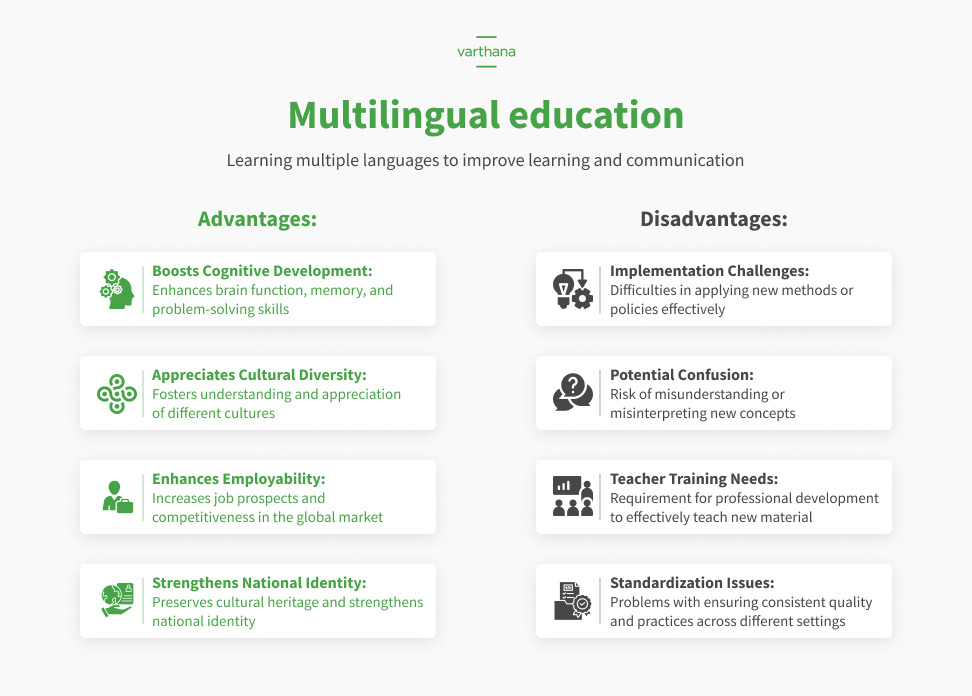
Benefits of Multilingualism in Education
Cognitive Development
Learning several languages enhances memory, problem-solving skills, and critical thinking abilities. For example, a student in Karnataka might speak Kannada at home, learn Hindi in school, and use English for instruction. This method helps the brain to adjust and manage multiple tasks efficiently.
Cultural Preservation
Multilingual education protects native languages and introduces global languages. Tamil-speaking students can read ancient texts by Thiruvalluvar in Tamil and also explore global literature in English.
Equitable Access
As discussed, one of the main characteristics of multilingualism is cultural awareness. By teaching in students’ native languages along with regional or national languages, schools can encourage students to participate in various cultural programs. In Assam, education is provided in both Assamese and English, allowing students to adjust while maintaining their cultural identity.
Academic Outcomes
Research indicates that multilingual students frequently achieve higher academic performance. For instance, studying Sanskrit can enhance grammar knowledge, logical reasoning, and sentence structure abilities, leading to better academic results.
National Integration
Speaking multiple languages encourages harmony among different areas. For instance, students in Punjab may study Punjabi, Hindi, and English, while those in Tamil Nadu study Tamil, Hindi, and English. This common understanding of language enhances respect and comprehension between individuals.
Global Readiness
Multilingual education equips students for participation in a global community. Many high schools provide French, German, or Spanish, allowing students to connect with others around the world.
Also Read: What Is Vocational Training
Challenges
Language Barriers at Home
Many students use one language at home and a different one at school. While simple conversations are easy, more in-depth discussions can be difficult because of unknown words and phrases.
Teacher Shortage
The role of teacher in multilingual classroom is important, but many do not have the training needed to teach in several languages or to manage diverse classrooms. Learning multiple dialects also takes a lot of time and effort.
Curriculum Balance
Managing several languages alongside other subjects is challenging. Teachers might focus more on important subjects, which can lead to less attention on language learning.
Focus on English vs Mother Tongue
English proficiency is important for career success, but focusing too much on it can sideline native languages, leading to cultural gaps.
Role of Teacher in Multilingual Classrooms
Training Needs
The role of teacher in multilingual classroom is undeniable. Hence, teachers require professional training for teaching multilingual students. Therefore, the training should cover how to manage linguistic diversity, use scaffolding techniques, and include multiple languages in lessons.
Pedagogical Strategies
Qualified teachers in multilingual classrooms:
- Use code-switching by switching between languages to explain ideas clearly.
- Use visual aids and multimedia to enhance understanding.
- Help students develop a strong understanding of existing language skills before introducing complex learning structures.
Inclusive Practices
A language-rich classroom featuring multilingual posters, labels, and books—encourages inclusivity. Peer learning can also help students benefit from each other’s strengths.
A classroom filled with language resources, such as multilingual posters, labels, and books, promotes inclusivity. Also, peer learning allows students to gain from each other’s strengths.
The role of teacher in multilingual classroom is not just to provide lessons but also to connect different cultures, making sure every student feels recognized and supported.
Implementation Strategies
Curriculum Design
Schools should adopt flexible curricula that reflect local languages and cultures. Lessons should include examples that connect to the students’ backgrounds.
Language Support Programs
Extra classes, language labs, and bilingual assistants can help students who are not as skilled. These supports improve the teacher’s role in a multilingual classroom by reducing learning gaps.
Parental and Community Involvement
Workshops for parents can assist them in supporting multilingual learning at home. Collaborating with community organizations can provide resources and activities that improve language skills.
Assessment and Evaluation
Testing methods should evaluate knowledge fairly in all languages. Formative assessments assist teachers in monitoring progress and modifying strategies.
Government Policy & NEP 2020
Article 350A of the Indian Constitution requires states to offer instruction in the mother tongue at the primary level for linguistic minorities.
- The NEP 2020 supports this commitment by recommending that teaching in the mother tongue or regional language should last until at least Grade 5.
- This policy supports fairness by making sure that all students can access quality education equally.
- Preserving culture means embracing native languages while also learning new ones.
- It improved retention rates and reduced dropouts among language minority groups.
By incorporating multilingual education into India’s system, the government makes sure that language serves as a bridge rather than a barrier.
Conclusion
Learning and teaching in different languages can be difficult, but the benefits are considerable. Multilingual education enables students to communicate effectively with individuals from various cultures, boosts their confidence, enhances academic performance, and fosters national unity.
The role of teacher in multilingual classroom is important, needing training, creativity, and participation from the community. India places great importance on its linguistic heritage, making multilingual education vital for building a more inclusive, equitable, and globally connected society.
Organizations like Varthana assist schools by offering resources, training for teachers, and innovative learning solutions. This helps to establish effective multilingual education, ensuring that every child has the chance to learn and succeed in their language while acquiring global skills.
Read More: English Project Ideas For Exhibition
FAQs
1.What is multilingual and its importance?
Multilingualism refers to the ability to use and understand multiple languages either by an individual or within a society. Its importance lies in:
- To encourage communication and understanding across diverse languages and cultural groups
- To strengthen cognitive abilities such as problem-solving and critical thinking
- To promote cultural awareness and inclusivity
- To appreciate and navigate different cultural surroundings
- To open up broader career opportunities and facilitate international collaboration.
2. What is the role of a teacher in a multilingual classroom?
Teachers are in control of supporting the diverse linguistic backgrounds of their students.
Using teaching strategies that influence students’ native languages while facilitating the acquisition of new languages.
Creating a curriculum by employing differentiated instruction and utilizing visual aids and bilingual resources to ensure comprehension.
They promote respect and understanding among students from various linguistic backgrounds as a cultural mediator.
3. How does multilingualism affect education?
Multilingualism affects education by improving cognitive ability, encouraging cultural awareness, and improving academic performance. Students who learn in multilingual surroundings often showcase better problem-solving skills, creativity, and critical thinking abilities. Students engage and appreciate diverse perspectives, making learning more relevant and meaningful.
However, this requires effective implementation with adequate resources and teacher training to address the challenges of balancing multiple languages in the curriculum. To address these challenges, you can take up loans from private banks or NBFCs to improve the teaching methodologies by implementing the resources or materials required.
4. What is the key concept of multilingual education?
Multilingual education promotes learning in multiple languages, boosting cultural understanding and academic success. Integrating native and new languages makes education more inclusive, enhances comprehension, and improves communication—highlighting the benefits of multilingualism in education.
5. What are the principles of multilingual education?
The principles of multilingual education are as follows:
- Inclusion of local languages: Education should include the mother tongue or regional languages to ensure better understanding.
- Gradual introduction of other languages: Introduce new languages step-by-step, allowing students to build a strong foundation.
- Cultural respect: Acknowledge and respect the cultural diversity of students through language learning.
- Student-centered approach: Opting for teaching methods to meet the diverse language needs of students.
- Equal opportunity: Ensure students of various language backgrounds have access to quality education.
It is extremely important to implement diversity in the classroom. This can start with the teacher’s awareness. Providing teachers with customized training can resolve many issues in a classroom. However, if you are facing any financial obstacles to doing so, then consider trusted NBFCs like Varthana.




Social