
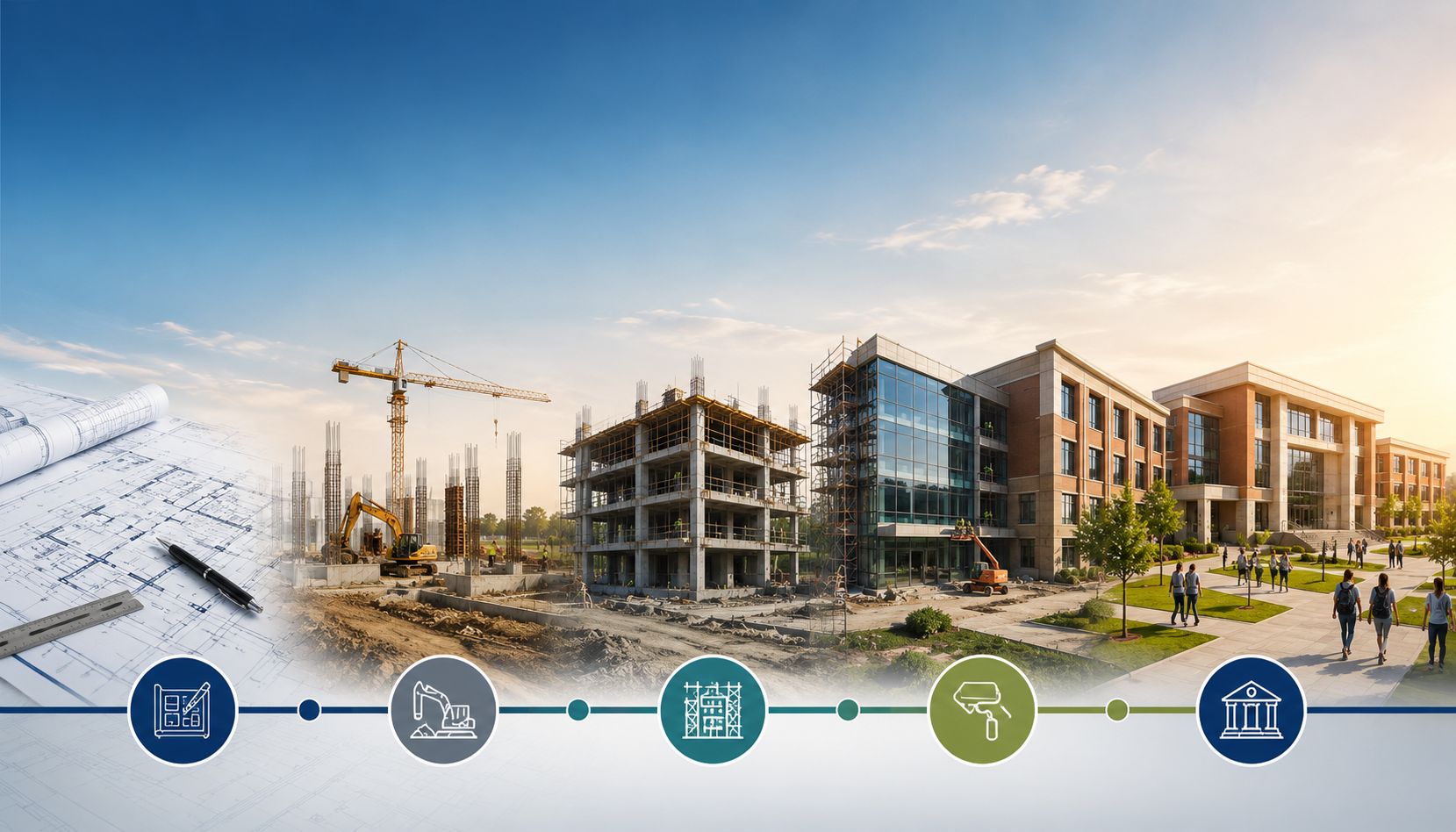
Every college campus starts with an idea, but turning that vision into reality takes more than just construction. It is an investment in better learning spaces, student growth and the institution’s success.
The National Education Policy (NEP) 2020 aims to increase India’s Gross Enrollment Ratio (GER) in higher education from 28.4% to 50% by 2035. As more students seek higher education opportunities, colleges need to strengthen their infrastructure to support this growth. This makes effective college infrastructure planning essential for institutions looking to expand their campus.
Whether a college is building a new academic block, upgrading labs, adding hostels or improving sports facilities, every project should follow a well-defined college infrastructure project timeline. A structured campus construction timeline helps institutions organize resources, secure funds, and execute projects efficiently while controlling costs and avoiding unnecessary delays.
What Is a College Infrastructure Project Timeline
A college infrastructure project timeline is a roadmap that outlines every stage of a construction project, from understanding infrastructure requirements to planning and constructing to handing over the facility. Dividing the project into smaller stages with clear roles, budgets and deadlines makes it easier for colleges to coordinate with teams, manage challenges and complete construction on time.
Why Planning Matters Before Construction Begins
Construction delays often occur due to problems that arise before work begins on site. Poor planning, a lack of coordination and unclear budgets can lead to delays, extra costs and last-minute changes that are difficult to manage. According to a McKinsey & Company report, large construction projects usually take 20% longer than planned and often exceed their original budgets by up to 80%.
These numbers highlight why college construction planning is essential. It helps colleges:
- Define project timelines
- Set a realistic budget
- Arrange funds before construction begins
- Obtain approvals and permits on time
- Identify risks
- Plan construction around the academic calendar
- Improve coordination between teams
Understanding the Stages of the College Construction Process
Here are the key stages involved in a college infrastructure project.
Stage 1: Define Infrastructure Requirements
Every college construction process begins with a clear understanding of the institution’s goals. College management should assess the following factors before moving ahead with construction.
- Current student enrollment
- Expected growth in admissions
- Faculty and staff requirements
- Capacity of existing buildings and facilities
- Upcoming academic programs
- Available space for expansion
For example, a college planning to introduce courses in microbiotechnology or biochemistry may need to invest in specialized laboratories rather than simply adding more classrooms. Similarly, if a college expects students to come from different states, expanding hostel facilities could be more useful than constructing another administrative block.
Identifying these needs early helps colleges invest in the right facilities and keeps the project on track from the very beginning.
Stage 2: Create a Detailed Project Plan
Once the infrastructure requirements are clear, the next step is to create a comprehensive project plan. This helps lay the foundation for successful college infrastructure planning.
The project plan should also include:
- Project goal
- Work scope
- Budget estimate
- Construction timeline
- Procurement plan
- Risk management approach
- Resource allocation
- Quality standards
A detailed project plan helps college management make informed decisions, coordinate with different teams and address potential challenges before construction begins.
Stage 3: Obtain Design and Regulatory Approvals
Once the planning is complete, the next step is turning ideas into detailed designs. While architects and engineers begin preparing detailed structural, electrical and plumbing designs, the college works to obtain building permits, fire NOCs and other required approvals.
Colleges also need to fulfill AICTE requirements by submitting land documents, approved building plans and the necessary compliance documents before construction can proceed.
Stage 4: Secure Funds
Access to adequate funding allows colleges to begin construction at the right time. Since campus expansion projects require significant investment, relying solely on internal funds is not always enough. That’s why many institutions turn to a college infrastructure loan. This bridges the funding gap and gives them the flexibility to begin construction when it’s needed.
Some of the key benefits of external financing include
- Starting construction instead of waiting years to accumulate funds
- Avoiding admission delays caused by a lack of infrastructure
- Keeping enough cash available for salaries, technology upgrades and daily operations
Stage 5: Begin Procurement and Contractor Selection
Once the designs are approved and all necessary permissions have been secured, the next big step is to select the right contractors and suppliers. Hiring experienced contractors helps keep the project on schedule and within budget.
Colleges should consider these factors when assessing contractors.
- Technical expertise
- Experience handling similar projects
- Performance on previous projects
- Ability to meet project deadlines
- Project management capabilities
- Safety practices and compliance
A fair and transparent bidding process allows colleges to compare contractors and choose the one best suited to the job. Providing clear project requirements from the start helps prevent confusion, mistakes and delays once construction begins.
Stage 6: Construction Stages for Colleges
The typical construction stages for colleges include:
- Site preparation: In this stage, the site is cleared, leveled and prepared for construction. Temporary fencing and utility connections are also set up.
- Foundation work: A strong foundation is built to support the structure.
- Structural construction: Columns, walls, beams and slabs are constructed to shape the building.
- Building services: Fire safety alarms, lifts, electrical wiring and plumbing are installed across the building.
- Interior finishing: It includes flooring, painting, furniture installation and setting up laboratories and digital infrastructure to prepare the campus for use.
Stage 7: Monitor Progress and Manage Risks
No construction project proceeds as planned. Unexpected weather, labor shortages, rising material costs, supply chain issues and delayed approvals can slow work and push timelines off track.
That’s why regular monitoring is an important part of college project execution. College management, architects, and contractors should assess progress through regular site visits and meetings. Tracking budgets, timelines, material availability, safety standards and overall quality helps everyone stay informed throughout the project.
Regular monitoring makes it easier to identify issues early on and address them promptly, helping avoid delays and unexpected expenses.
Stage 8: Final Inspection and Campus Readiness
As construction comes to an end, the emphasis shifts from building to getting the campus ready for students and faculty. Prior to opening, colleges perform structural inspections, safety checks, furniture installation, technology setup and a final round of campus cleaning.
Once everything has been tested and all required approvals have been obtained, contractors hand over operating instructions, warranties and maintenance manuals. Facility teams are also trained to oversee the building and its essential systems.
Once these final steps are complete, the campus is ready to welcome students and faculty.
How the Right Financial Partner Supports Successful Project Execution
Choosing the right financial partner helps colleges manage construction smoothly from start to finish. As an education-focused Non-Banking Financial Company (NBFC), Varthana offers college loan solutions with flexible repayment schedules, allowing colleges to align loan repayments with their cash flow.
Varthana offers two types of college construction loans or expansion.
Secured loans (Collateral required)
- Suitable for large-scale college construction or expansion projects
- Loan amount up to ₹10 crore
- Repayment tenure up to 12 years
- The college should have been operating for at least three years
- Must have 200 or more students
Unsecured loans (No collateral required)
- Ideal for smaller construction or renovation projects
- Loan amount of 10-25 lakhs
- Repayment tenure up to 60 months
- College should have operated from the owner’s premises for at least five years
- Minimum student strength of 400
- Annual fee collection of ₹1 crore or more
Planning to expand your campus? Partner with Varthana for a college expansion loan tailored to your institution’s needs.
FAQs
Q1: What is a college infrastructure project timeline?
Ans: A college infrastructure project timeline is a plan that outlines each stage of a construction project, from planning and design approvals to inspection and final handover.
Q2: What factors affect a college construction timeline?
Ans: Some of the factors that affect a college construction timeline include project size, approvals, funding, contractor performance and weather conditions.
Q3: What should colleges consider before starting a construction project?
Ans: Colleges should assess their space needs, budget, approvals and future expansion plans before construction begins.
Q4: How can colleges finance infrastructure development?
Ans: Colleges can use internal funds, government grants, or external financing, such as a college infrastructure loan by Varthana, to finance construction and manage cash flow.
Q5: What are the main construction stages for colleges?
Ans: Most college construction projects follow the same basic process, which includes planning, design, approvals, financing, contractor selection, construction, inspections and final handover.





Social