
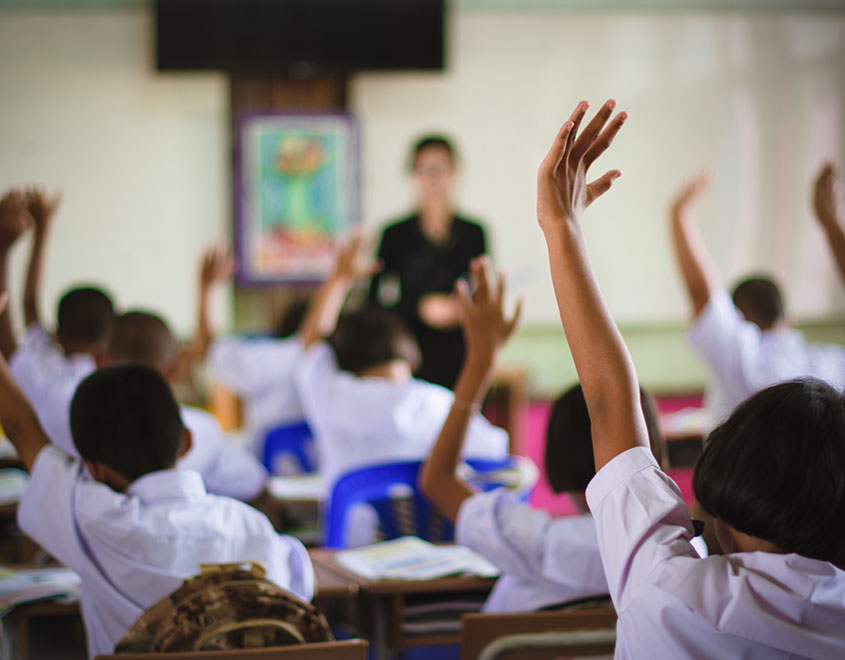
A school provided a science project for two groups from different classrooms. The two classrooms differed in what the class teacher taught beyond the syllabus, especially in terms of value education and life skills. The common challenge both groups faced was that the working model in the project failed to work. However, let’s try and focus on how the two groups responded to the challenge:
- In one group of Class A, students blamed each other, gave up quickly, and waited for the teacher to fix it.
- In the other group of Class B, students calmly displayed patience and discussed what went wrong. They brainstormed and decided to try again until it worked.
The two groups responded to the challenge differently. Why?
The class B teacher probably taught beyond the classroom and tried building life skills and values, the invisible lessons that help children handle the real world with confidence, kindness, and purpose.
What Studies Say
According to PARAKH Rashtriya Sarvekshan 2024, conducted by NCERT’s National Assessment Centre, only 47% of schools in India offer skill-based courses for students in Class IX and above. Furthermore, participation in these courses is notably lower, with just 29% of students opting for such vocational life skills based education. So, values and life skills education in schools have become the need of the hour.
Core are not Optional
National Education Policy (NEP) 2020, NCERT / National Curriculum Framework (NCF) & NCERT advisories (2023–2024), Boards and curriculum updates (CBSE 2024–25 curriculum) recommend making life skills and values a part of the school curriculum. Integrating these skills in advance will make a difference in every student’s life.
Also read: How Private Colleges Can Access Finance for Campus Expansion?
Life Skills and Values
Communication, decision-making, problem-solving, emotional regulation, teamwork, digital or financial literacy and critical thinking and many more practical abilities that help children face everyday challenges are Life skills. Honesty, empathy, respect, responsibility and other beliefs and attitudes that guide behaviour in students are Values.
The difference between values and skills is that values tell us why we act a certain way, while skills show how we act. Together, they help children make the right choices and carry them out effectively.
Importance
Life skills and values, when taught well, prepare students for life – not just academics. You can see improved classroom engagement, student discipline, and real-life readiness. With life skills and values:
- Academics, attendance, communication, teamwork, problem-solving skills improve.
- Stress and change are handled with resilience.
- Safe, kind and wiser choices are made and build healthier relationships.
- Their future – career, work, and life – is set on a stronger foundation.

The Role of Schools
How about turning your school into a live laboratory of life skills and values? You need to follow a few things as follows:
-
-
Curriculum integration
Subjects need to be taught by including life skills and values. For example:
- Languages – Try using writing and discussions to encourage students to express students’ thoughts and emotions.
- Social Studies – Conduct discussions on relevant social and political issues, as this can promote critical thinking and empathy in students.
- Science – Problem-solving skills and teamwork can be imparted to students through hands-on experiments
-
Co-curricular activities
Promote life skills values with activities like,
- Students who join debate clubs learn to communicate better through their development of critical thinking and decision-making abilities.
- Students who do community service develop empathy through their experiences which makes them into authentic responsible citizens of society.
- Sports programs provide students with physical exercise while teaching them essential life skills including teamwork and emotional control and self-discipline.
- A classroom charter functions as a soft reminder of core values including honesty and teamwork which helps all students understand the class’s fundamental principles.
-
Teacher training
Professional development of teachers in schools needs to focus on imparting the necessary skills to teach life skills and values.
- Include workshops on effective communication and classroom management.
- Implement resources for integrating life skills into lesson plans.
- Encourage teachers to model positive behaviours and values.
-
Parental Involvement
Orienting and including parents in the process of building life skills and values in students through workshops and relevant activities can encourage parents to reinforce these skills at home and even in school. Thus, create a partnership between school and home to support student development
-
Also read: Why Soft Skills are the Secret Weapon for Academic and Life Achievement
Keep It Real
-
- Blend, don’t add burden: Combine life skills education with existing subjects rather than treating them as additional subjects or activities.
- Model first: Teachers who demonstrate the values and skills get more acceptance from students.
- Simple assessment: Small, consistent assessments and records are more useful than long, periodic reports.
- Be inclusive: Adapt methods for all types of learners and make activities accessible.
We always hear, ‘education goes beyond marks and grades’, value education and life skills make it stronger. Integrating life skills and values takes your schools to the next level. Your students will learn how to think, feel and act and not just what to think. Feel proud to see them understand themselves, respect others, and courageously face challenges and grow as good human beings. Align your school vision and goals, life skills and values and witness the positive transformation in your educational framework.
Challenges in Promoting Life Skills and Values in Schools
Most educators understand the value of life skills education in schools, yet the actual implementation faces numerous obstacles:
- Educational institutions face challenges because they lack sufficient time and resources while dealing with excessive academic requirements.
- The main challenge that prevents schools from teaching life skills education arises from their already full curriculum schedule. Teachers must manage their time between teaching core subjects and administrative duties, which leaves them no space for life skills education.
- The lack of trained teachers in schools creates a major challenge for life skills education implementation. The teaching process of life skills needs facilitators who will help students through reflective activities and lead important discussions while demonstrating emotional intelligence.
- The school assessment process encounters various obstacles when it attempts to execute its established procedures. The evaluation process for empathy and resilience assessment needs distinct assessment approaches that differ from traditional math testing methods. Schools require funding to create suitable assessment methods because they lack both sufficient expertise and sufficient time.
Common Challenges
- Curriculum packed with academic requirements
- Teachers who haven’t been trained to deliver skill-based sessions
- Difficulty measuring behavioural and emotional growth
- Lack of physical spaces for activities
Practical Solutions
- The program needs to add life skills training to its existing educational activities, which include language class discussions and science group assignments.
- Use simple observation checklists instead of exam-style assessments.
- Provide regular teacher workshops, even short, low-cost ones.
- Encourage peer learning and student-led activities.
- Partner with organisations for resource support
The financial support from NBFCs, such as Varthana, enables schools to build better infrastructure, develop spaces for activities, and expand their life skills education in school programs. The right financial backing enables schools to handle their current obstacles more effectively.
The Difference Between Life Skills and Values Explained
People who work with children and their families frequently ask about the basic difference between values and skills. Values and skills appear similar at first glance because they share common characteristics, yet they produce distinct effects on child development.
Life Skills
These are the practical abilities that help students handle everyday situations. They grow through experience, practice, and reflection. Examples include:
- Communicating clearly
- Managing emotions
- Solving problems
- Making thoughtful decisions
- Working with others
Life skills answer the question: “How should I respond?”
Values
Values run deeper. They are the beliefs that guide behaviour and shape character. Children absorb values by observing adults, through conversations, and from the culture around them. Key values include:
- Respect
- Honesty
- Compassion
- Responsibility
- Integrity
Values answer the question: “Why should I act this way?”
When combined, they create what many educators refer to as life skills values – the powerful blend of ability and intention.
In Simple Terms
- Skills shape behaviour; values shape character
- Skills are practised; values are internalised
- Skills produce outward actions; values influence inner choices
Students require skills to execute their work but values direct them to finish tasks with purpose and moral integrity. The development of skills and values in young people leads to capable individuals who possess stability and readiness for their future.
Conclusion
Schools that teach life skills and values create educational advantages that go beyond classroom learning because they help students become confident, compassionate individuals who handle challenges through peaceful determination and emotional understanding. Life skills education in schools for children happens through classrooms that receive purposeful experiences, dedicated teachers, and appropriate educational materials. The development of essential life skills during childhood creates responsible citizens who will lead society in the future.
FAQs
-
What are some examples of life skills and values taught in schools?
Students often learn things like communication, empathy, teamwork, responsibility, and problem-solving as part of life skills and values programs.
-
How do life skills help with future careers?
Employers value leadership, adaptability, and emotional intelligence – all of which grow through strong life skills values.
-
Can children learn life skills and values outside the school environment?
Absolutely. Homes, playgrounds, and communities often teach lessons that last a lifetime.
-
How do schools assess life skills and values?
Through observation, student reflections, group activities, and teacher feedback – not just exams.
-
What role do parents play?
Parents shape the foundation of value education and life skills through everyday interactions, routines, and conversations.
-
Can non-traditional schools or alternative learning spaces adopt life skills based education?
Yes. These environments often adapt even more easily to life skills based education, since they naturally use experiential and project-based learning.




Social